Step into a newly constructed 5 Marla home in Wah, Rawalpindi, or Islamabad, and you will notice a common architectural constraint: standard ceiling heights hovering around 9.5 to 10 feet. When paired with compact room layouts, traditional lighting choices—like a harsh, glaring central tube light or a flat surface-mounted LED panel—tend to visually compress the space. They create high-contrast shadows in the corners, cast an unflattering glare downward, and make an already cozy room feel cramped and clinical.
Yet, walk into a high-end luxury hotel suite, and the ambiance instantly shifts. The room feels expansive, serene, and effortlessly bright, even though you cannot spot a single glaring bulb.
The secret isn’t higher wattage or more fixtures. It is lighting architecture.
By utilizing engineered false ceiling “pockets” and indirect cove lighting, you can fundamentally transform the optical distribution of light in your home. This approach doubles your perceived room brightness, elevates your interior aesthetic, and slashes your energy consumption. Here is how modern ceiling design uses physics and style to redefine local residential spaces.
1. Direct vs. Indirect Lighting: The Science of Visual Comfort
To understand why traditional setups fail, we have to look at how the human eye processes light.
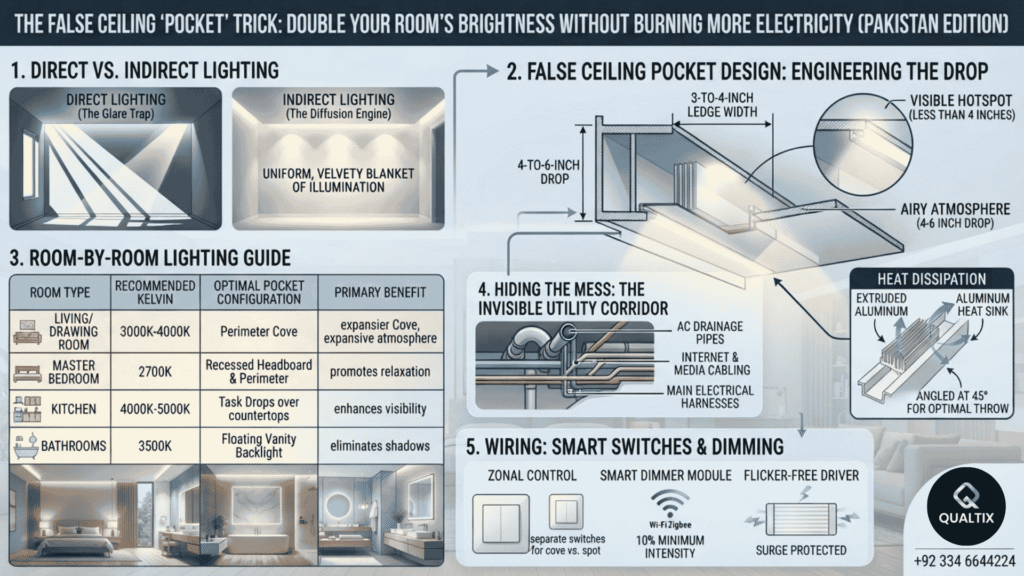
- Direct Lighting (The Glare Trap): Standard surface panels or hanging fixtures shoot 100% of their lumens straight down. This creates harsh hotspots on your floor and furniture while leaving walls in relative shadow. The high contrast between the blinding light source and dark surroundings strains your eyes, triggers headaches, and emphasizes every minor imperfection in your wall paint.
- Indirect Lighting (The Diffusion Engine): Cove lighting hides the source entirely. Instead of hitting your eyes directly, the light bounces off a secondary surface—usually a specially finished gypsum drop or a matte-white ceiling cavity.
This bouncing action scatters photons in millions of random directions, creating a uniform, velvety blanket of illumination. By eliminating harsh shadows, your brain perceives the room as larger, brighter, and infinitely more open.
2. The False Ceiling Pocket Design: Engineering the Drop
You cannot simply stick an LED strip behind a random piece of drywall and expect a luxury hotel effect. True architectural cove lighting requires precision engineering, especially when dealing with standard 5 Marla and 7 Marla ceiling heights.
The 4-to-6-Inch Rule
When designing a cove drop in a Pakistani home, the vertical drop-down measurement is critical:
- The Drop: A standard drop of 4 to 6 inches is the sweet spot. Anything less than 4 inches will trap the light source too tightly, creating a visible “hotspot” line where individual LED diodes can be seen through the opening. Anything greater than 8 inches in a standard 9.5-foot room will visually weigh down the ceiling, defeating the purpose of creating an airy atmosphere.
- The Ledge Width: The horizontal lip or shadow gap should typically measure between 3 to 4 inches, providing a deep enough recess to completely conceal the aluminum housing and wiring harness.
Beating the Heat Trap
LEDs are energy-efficient, but they still generate thermal energy at the micro-chip level. If sealed inside an enclosed gypsum cavity with zero airflow, that heat builds up, drastically shortening the lifespan of the LED driver and causing the diodes to dim prematurely (lumen depreciation).
Professional installations always incorporate extruded aluminum LED channels fixed inside the pocket. These aluminum profiles act as heat sinks, drawing thermal energy away from the strip while providing a clean, professional mounting angle (usually angled at 45 degrees toward the main ceiling plane to maximize light throw).
3. Room-by-Room Lighting Guide
Different living spaces require different Kelvin (color temperature) ratings and pocket configurations to achieve optimal functionality and mood.
| Room Type | Recommended Kelvin (Color Temp) | Optimal Pocket Configuration | Primary Benefit |
| Living Room / Drawing Room | 3000K (Warm White) to 4000K (Natural White) | Perimeter Perimeter Cove with Dual-Switch Zoning | Creates an expansive, welcoming atmosphere for guests without eye fatigue. |
| Master Bedroom | 2700K (Extra Warm / Cozy) | Recessed Headboard Wall Cove & Perimeter Drop | Promotes melatonin production and relaxation by eliminating overhead glare. |
| Kitchen | 4000K to 5000K (Cool White / Task) | Task-Focused Perimeter Drops over Countertops | Enhances visibility for food preparation while maintaining a sleek, modern look. |
| Bathrooms | 3500K (Neutral White) | Floating Vanity Backlight & Mirror Coves | Eliminates harsh facial shadows, making grooming precise and flattering. |
4. Hiding the Mess: The Invisible Utility Corridor
One of the most overlooked functional advantages of a false ceiling pocket is its capability as a utility highway. In modern residential construction, keeping exposed wiring and piping out of sight is a major challenge.
The hollow cavities created during false ceiling installation serve as an ideal concealment zone for:
- AC Drainage Pipes: Sloped condensation lines running from split AC units can be routed invisibly through the ceiling framing rather than cutting ugly channels into structural brick walls.
- Internet & Media Cabling: Cat6 ethernet cables, HDMI lines, and sound system wiring can be neatly bundled and run across the room without messy surface-mounted plastic casing (ducts).
- Main Electrical Harnesses: Junction boxes and heavy-duty transformer drivers for high-output LED strips can be safely tucked away inside the ceiling cavity while remaining accessible via discreet maintenance trapdoors.
5. Wiring Considerations: Smart Switches and Dimming Integration
A luxury lighting design is only as good as its control system. Relying on a single, old-school toggle switch defeats the purpose of investing in architectural coves.
- Zonal Control: Separate your perimeter cove lights from your direct spotlight accents. This allows you to shift the room from a bright, high-energy daytime workspace to a soft, intimate evening lounge with the flip of a secondary switch.
- Smart Dimmer Integration: Modern Wi-Fi and Zigbee-compatible dimmer modules let you fine-tune the lumen output of your LED strips down to 10%. Lowering the intensity at night reduces eye strain and cuts your electrical power draw down to a fraction of a standard bulb.
- Driver Quality Matters: Always insist on constant-voltage, flicker-free LED drivers (power supplies) with built-in surge protection—an absolute must to handle local voltage fluctuations and load shedding spikes safely.
Partner with Qualtix
Transforming a cramped room into a luminous, modern sanctuary requires more than just drywall and lights; it demands precise spatial planning, thermal management, and clean electrical engineering.
Partner with Qualtix to design custom, future-ready false ceilings that blend lighting architecture seamlessly into your interior. Contact our engineering team today to elevate your living spaces with precision and style.