If you live in Rawalpindi, Islamabad, or Lahore, you already know the dreaded feeling. You walk into a top-floor bedroom at 8:00 PM in the middle of June, and it feels like stepping inside an active oven. The walls are radiating heat, the ceiling feels like a stovetop, and your 1.5-ton Inverter AC is screaming at maximum capacity, desperately trying to cool a room that refuses to drop below 28°C.
As a Senior Civil Engineer and Sustainable Building Expert with over 15 years of experience fighting the brutal Pakistani climate, I constantly see homeowners making the same expensive mistake. They spend millions on interior aesthetics, imported tiles, and luxury fixtures, but leave their roof completely exposed to the sun.
In 2026, with electricity unit rates breaking historical records, relying purely on your Air Conditioner to fight structural heat is a financial death sentence. You cannot out-cool a poorly engineered roof. You must stop the heat before it enters the building.
Welcome to the ultimate guide on Value Engineering your roof. Today, we are going to dissect the “Top-Floor Trap” and reveal how combining traditional wisdom with modern materials specifically the Clay Tile Hack can permanently drop your indoor temperature by up to 5°C, transforming your electricity bill from a source of anxiety into a manageable expense.
The “Top-Floor Trap”: Why Your Bedroom Feels Like an Oven
To solve the heat problem, you must first understand the physics of a standard Pakistani roof, locally known as the Lanter.
A standard 6-inch reinforced concrete (RCC) slab is incredibly dense. From an engineering perspective, concrete possesses extreme Thermal Mass. This means it acts as a massive “heat battery.” From 8:00 AM to 6:00 PM, the summer sun beats down relentlessly on your exposed roof. The concrete absorbs this solar radiation all day long, storing the thermal energy deep within its molecular structure.
When the sun goes down, the outside air cools, but your concrete roof does not. It begins to discharge its stored heat battery, radiating that stored thermal energy downwards into your top-floor bedrooms. This phenomenon is why your AC compressor never “trips” (goes into power-saving mode) at night; it is constantly fighting a 6-inch thick slab of concrete that is actively heating the room from above.
To break this cycle, you need a Thermal Barrier.
The Core Concept: Thermal Mass and Solar Reflectance
To engineer a climate-proof roof, we must use materials that possess a high Thermal Lag (materials that take a very long time to heat up) and low thermal conductivity. For centuries, our ancestors in the subcontinent used the perfect material for this: Khaprail (Terracotta Clay Tiles).
The Science of “Khaprail” (Clay Tiles)
Terracotta clay is a natural, highly effective insulator. Unlike concrete, clay is highly porous. When baked into tiles, these microscopic pores act as tiny air pockets. Because still air is one of the worst conductors of heat, these tiles naturally block thermal transfer.
Furthermore, the physical shape of traditional Khaprail (curved or ribbed) creates a physical air gap between the tile and the surface below it. When the summer sun hits the clay tile, the heat struggles to penetrate the porous material, and whatever heat does make it through gets trapped and dispersed in the air gap beneath the tile. It never reaches your concrete Lanter.
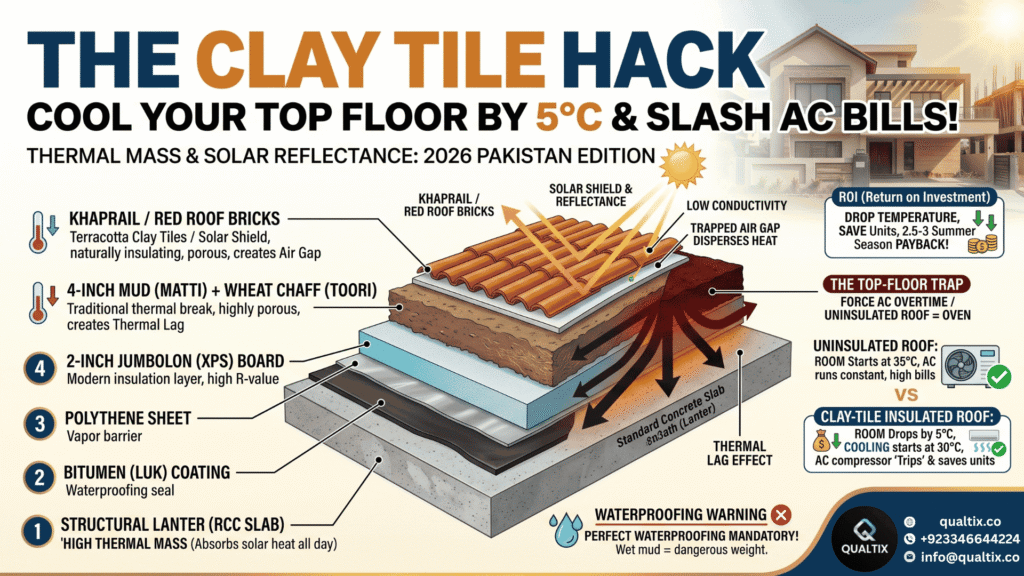
🏗️ The Ultimate Pakistani Roof: Cross-Section Diagram Explanation
Simply throwing some clay tiles or red roof bricks onto a bare concrete roof will not work. In modern 2026 construction, we use a hybrid system that combines the ancient wisdom of clay with the modern science of synthetic insulation.
Here is the exact, multi-layered engineering protocol we use at Qualtix to build an impenetrable thermal barrier. Imagine cutting a slice out of a perfectly engineered roof. From bottom to top, here are the layers:
- The Structural Base (The Lanter): Your standard 6-inch RCC concrete slab. Must be properly cured and swept completely clean of dust and debris.
- The Waterproofing Seal (The Luk): A heavy, double-coat application of premium hot Bitumen (Luk). This is your primary defense against water. It seals the micro-pores in the concrete.
- The Vapor Barrier (Polythene Sheet): A heavy-duty plastic polythene sheet is laid over the sticky bitumen. This prevents rising moisture from the concrete from reaching the upper layers and acts as a secondary waterproof membrane.
- The Modern Insulator (The Jumbolon Board): We lay down 2-inch thick Extruded Polystyrene (XPS) insulation boards, commonly known in the local market as Jumbolon. This synthetic foam has extremely high thermal resistance and acts as a hard stop against any heat attempting to travel downward.
- The Traditional Thermal Break (Matti + Toori): A 4-inch thick layer of dry mud (Matti) mixed with wheat chaff (Toori). The wheat chaff adds tensile strength to the mud (preventing deep cracks) and introduces thousands of microscopic air pockets. This layer adds weight to hold the Jumbolon down, provides the necessary slope for water drainage, and acts as a massive thermal sponge.
- The Solar Shield (Khaprail or Roof Bricks): The top surface. Terracotta clay tiles or flat red roof bricks are laid over the mud.
- The Grout Lock: The joints between the tiles are heavily grouted with a rich cement mixture to prevent any surface water from penetrating down into the mud layer.
⚠️ CRITICAL WARNING: The Waterproofing Rule & Shor/Seem
The entire Jumbolon and Mud system is a miracle for heat prevention, but it has one fatal vulnerability: Water. If your top layer of tiles is poorly grouted and rainwater leaks into the 4-inch Matti layer, you will face a disaster. Mud absorbs water like a sponge. A wet mud layer becomes exponentially heavier, adding massive, dangerous “dead weight” to your structural Lanter. Furthermore, the trapped water will eventually find a way through the bitumen, resulting in devastating Shor/Seem (dampness, peeling paint, and mold) on your beautiful bedroom ceilings below. Roof insulation must always be paired with flawless, zero-tolerance waterproofing.
The Modern Alternative: White Reflective Paint (Elastomeric Coatings)
If your house is already built, and you do not have the structural load capacity or the budget to add 4 inches of mud and heavy clay tiles to your roof, there is a modern, high-tech alternative: The Albedo Effect.
Albedo is a scientific measure of how much solar energy a surface reflects. A standard grey concrete roof has a low albedo; it absorbs up to 90% of solar radiation. By thoroughly cleaning your roof and applying a premium, pure white Elastomeric Reflective Paint coating, you completely flip the physics of your roof.
A high-quality reflective coating bounces up to 80% of the sun’s UV and infrared rays back into the atmosphere before they can even heat up the concrete.
Clay Tiles vs. Reflective Paint: The 2026 Showdown
- Longevity: Clay tiles, once installed, will easily outlast you. They are a multi-generational solution. White reflective paint, however, is exposed to acid rain, intense UV degradation, and dust storms. In the Pakistani climate, these coatings typically lose their reflective brilliance and require re-application every 3 to 5 years.
- Maintenance: A tiled roof requires occasional checking of the grout lines. A painted roof requires frequent washing, because if the white paint gets covered in brown dust, it loses its reflective power and starts absorbing heat again.
- The Verdict: Paint is an excellent temporary or budget-friendly retrofit. The Jumbolon + Mud + Clay Tile system is the ultimate, permanent engineering solution.
📊 Myth vs. Fact: The Pakistani Roof
| The Local Myth | The Engineering Fact |
| Myth: “Spraying the roof with a water hose in the evening cools the house down.” | Fact: It provides only 15 minutes of relief. The water evaporates instantly off the 50°C concrete, and the massive thermal battery inside the slab continues radiating heat into your room all night. |
| Myth: “False ceilings (Plaster of Paris) stop the heat from the roof.” | Fact: False ceilings only hide the heat. The 1-foot gap above the false ceiling turns into an oven, which eventually transfers the heat down into your room anyway. You must stop the heat on the exterior of the roof. |
| Myth: “Red bricks on the roof are just for decoration.” | Fact: Red baked bricks are highly effective thermal insulators. When placed over mud, they absorb the brunt of the UV impact, sacrificing themselves to keep the concrete below cool. |
💰 The Electricity Bill ROI (Return on Investment)
Let’s talk about the numbers that actually matter. In 2026, electricity in Pakistan is a luxury commodity.
A standard 1.5-ton DC Inverter AC is a miracle of modern tech. Unlike old ACs that run at 100% power constantly, an Inverter adjusts its compressor speed. When you set your AC to 26°C, the compressor runs at maximum power (drawing around 1500 to 1800 Watts) until the room hits 26°C. Once the target temperature is reached, the compressor slows down or “trips,” drawing as little as 300 to 400 Watts just to maintain the temperature.
Here is the financial magic of dropping your ambient temperature by 5°C:
- The Uninsulated Roof: The room starts at a scorching 35°C. Your AC fights the heat radiating from the ceiling all night. It never reaches the target 26°C. The compressor runs at 1800 Watts for 10 straight hours. Daily Cost = Astronomical.
- The Clay-Tile Insulated Roof: Because the heat was blocked, the room starts at a manageable 30°C. The ceiling is cool to the touch. Your AC reaches the target 26°C in just 45 minutes. For the next 9 hours, the compressor “trips” down to 400 Watts.
Your Monthly Savings:
- You save roughly 6 to 8 electricity units per night, per AC.
- If you run two ACs on the top floor, that is a saving of up to 480 units a month.
- At current high-slab tariff rates, this translates to saving PKR 30,000 to PKR 40,000 every single month during the summer peak.
- The ROI: The cost of installing a Jumbolon + Mud + Tile roof pays for itself entirely in AC electricity savings within just 2.5 to 3 summer seasons. After that, the insulation literally makes you money.
Engineer Your Climate Defense
Building a home in Pakistan in 2026 is no longer just about raising walls and pouring a roof; it is about engineering a defense against a rapidly changing, increasingly hostile climate. Relying on sheer electrical power to keep your family comfortable is a losing battle. You must use Value Engineering to make your house work for you, not against you.
At Qualtix, we don’t just build shelters; we engineer high-performance living spaces. Our teams specialize in climate-conscious design, ensuring every home we build in Wah, Rawalpindi, and Islamabad features advanced thermal barriers, flawless waterproofing, and absolute structural integrity.
Stop paying the ultimate price for a poorly engineered roof. Whether you are starting a new build in Kohistan Enclave or New City Phase 2, or you need to retrofit your existing home to survive the summers, you need expert guidance.
Contact Qualtix today to schedule a comprehensive “Climate-Proof Roof Assessment” and let us engineer a permanent solution to slash your energy bills.