If you walk into a newly constructed residential property in Wah, Rawalpindi, or Islamabad today, you will likely marvel at the slick granite countertops, the modern tile layouts, and the flawless emulsion paint. But step over to the wall plate, flip on the light, and you are stepping into an electrical philosophy that hasn’t changed since the 1980s.
Ask any local homeowner who has tried to upgrade their house with smart lighting, automated scene controllers, or app-controlled touch switches about their experience, and you will usually hear a groan of frustration. Within weeks of moving in, they discover a frustrating bottleneck: their shiny new Wi-Fi smart switches either refuse to power up, flicker constantly, or require them to tear open newly plastered walls just to pull a missing wire.
In modern residential electrical engineering, there is one invisible, low-cost component that dictates whether your home is ready for the future or stuck in the past: The Neutral Wire.
If you are planning or building a home, ignoring this single requirement during the rough-in wiring phase is a catastrophic mistake. Here is why ensuring a neutral wire in every single switch box right now is the ultimate secret to a future-proof smart home.
1. The Legacy Switch Problem: Why Your Walls Will Have to Be Chopped Open Later
To understand why smart switches fail in standard Pakistani homes, you first need to understand how traditional wiring works.
The Old-School “Live-Only” Loop
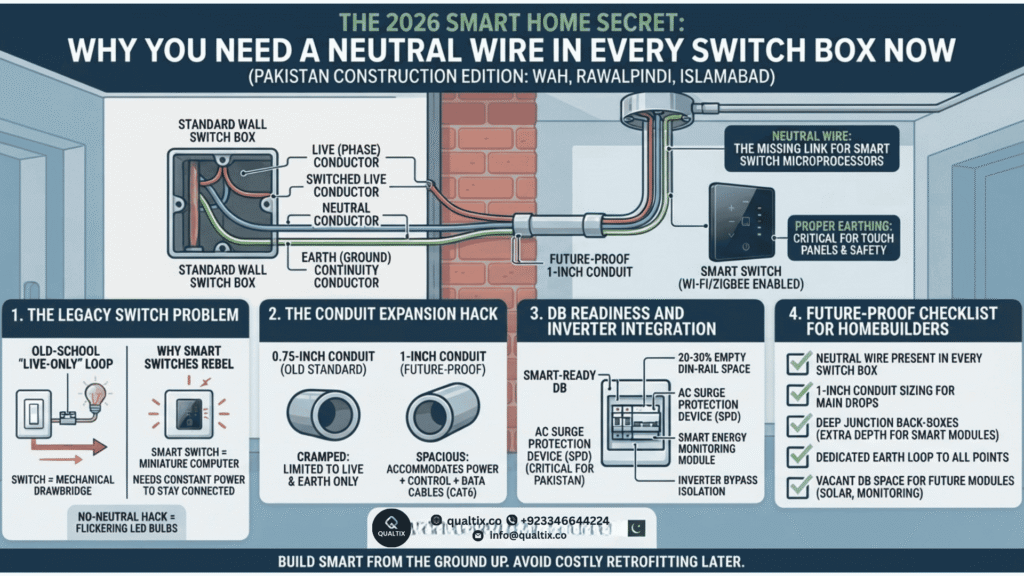
For decades, local electricians have used a single-conductor loop to wire switches. When a mason runs conduits and the electrician pulls wires through them, they typically bring only the Live (Phase) wire down to the switch plate. The switch acts like a simple drawbridge: when you flip it “On,” it bridges the gap, sending the Live current directly up to the bulb. When you flip it “Off,” the bridge opens and power stops.
The bulb completes its circuit by running its own return line back to the main distribution board via a Neutral wire, which is usually tucked safely away inside the ceiling junction box, far above the switch plate on the wall.
Why Smart Switches Rebel
A smart switch is not a simple mechanical bridge. Unlike traditional plastic toggles, a smart switch is essentially a miniature computer. It features an internal Wi-Fi or Zigbee radio chip, a touch-sensitive glass face, LED indicator lights, and a relay.
For this micro-computer to stay connected to your home network and wait for your voice command or phone tap, it needs constant, uninterrupted electrical power.
- The “No-Neutral” Hack (And Its Flaws): Some cheap smart switches claim to operate “without a neutral wire.” They do this by tricking the system, allowing a microscopic trickle of current to pass through the light bulb even when it is turned off.
- The Result: If you use energy-efficient LED bulbs with these no-neutral switches, that tiny trickle of current causes the bulbs to flash, flicker ghost-like in the middle of the night, or burn out prematurely. High-end smart switches from global brands (like Sonoff, Aqara, or Tuya Zigbee hubs) refuse to work at all without a dedicated, direct Neutral wire.
If your electrician didn’t drop a Neutral wire into every single switch box during the initial rough-in phase, your only option later is to hire a mason to cut open your finished walls, chase out the conduits, and pull new wires—destroying your fresh paint and tiles.
2. The Anatomy of a Smart Switch Box
To visualize what a modern, future-proof electrical box should look like behind the scenes, consider this structured breakdown of internal wiring requirements:
- The Live (Phase) Conductor: Carries incoming 230V power from the distribution board to the switch.
- The Switched Live Conductor: Carries the controlled power output from the switch up to the light fixture or ceiling fan.
- The Neutral Conductor (The Missing Link): Runs continuously through the switch box from the main distribution line, completing the closed circuit required to power smart switch microprocessors.
- The Earth (Ground) Continuity Conductor: Protects users against electrical shocks, especially critical when installing glass-faced capacitive touch panels or metal-trimmed designer switch plates.
3. The Conduit Expansion Hack: Upgrading from 0.75″ to 1″
Wiring is only as good as the pathway holding it. In typical local construction, electricians use standard 0.75-inch flexible or rigid PVC conduit pipes embedded in the brickwork to route wires.
While 0.75-inch pipes are adequate for running a basic Live and Earth wire for a single light bulb, they quickly become jammed when you try to introduce future-proofing upgrades.
The 1-Inch Rule for 2026
If you want a truly smart, modular home, instruct your contractor to use a minimum of 1-inch conduit pipes for all main switch drops and vertical chases.
A 1-inch conduit provides the internal cross-sectional area needed to easily accommodate:
- Standard power wiring (Live, Neutral, and Earth).
- Extra control loops for multi-way stairwell switching.
- Low-voltage communication lines (such as CAT6 ethernet cables for hardwired smart control panels or security intercoms).
By future-proofing your conduit sizing before the plaster goes on, you ensure that pulling a new wire 5 or 10 years down the line takes an electrician 10 minutes instead of requiring a hammer and chisel.
4. Main Distribution Board (DB) Readiness and Inverter Integration
Smart infrastructure doesn’t stop at the wall switch; it begins at the heart of your home’s electrical layout: the Main Distribution Board (DB).
In Pakistan’s energy landscape—marked by frequent load shedding and fluctuating grid voltages—almost every modern home relies on a hybrid solar inverter system or a heavy-duty UPS.
Designing a Smart-Ready DB
- Physical Space Allowance: When your electrician designs the DB panel box, ensure they leave at least 20% to 30% empty DIN-rail space. As you integrate smart home energy monitors (like Emporia or Shelly 3EM meters) or smart circuit breakers later, you will need physical space inside the box to mount them.
- Surge Protection Devices (SPDs): Sensitive smart home automation hubs, routers, and touch panels are vulnerable to voltage spikes caused by grid restoration after load shedding or nearby lightning strikes. Installing a dedicated AC Surge Protector in your main DB safeguards your entire smart ecosystem.
- Inverter Bypass and Isolation: Clearly segregate heavy loads (like AC units and water pumps) from sensitive lighting and automation circuits so your system can manage power efficiently without tripping main breakers.
5. Safety & Earthing: The Non-Negotiable Baseline
As homes become smarter, integrating more digital components, touch surfaces, and metal-encased appliances, electrical safety cannot be an afterthought.
Many local practices cut corners by skipping earth wires in switch loops, assuming that lights “don’t need grounding.” This is a dangerous misconception. Modern smart switches with glass touch panels and capacitive sensors rely heavily on proper earthing to stabilize touch sensitivity and protect against static discharge or internal component failure.
Every switch box in your home must feature a dedicated earth continuity conductor connected back to a copper earth rod buried deep in the foundation. It protects your family, secures your expensive automation hardware, and ensures code-compliant safety.
Future-Proof Checklist for Homebuilders
Before you sign off on your electrical rough-in phase, verify these points with your contractor:
- Neutral Wire Present: Are neutral wires looped into every single wall switch box, or just the ceiling outlets? (Demand them at every switch).
- Conduit Sizing: Are vertical conduit drops sized at 1 inch rather than the cramped 0.75-inch standard?
- Deep Junction Boxes: Are deep-profile switch back-boxes installed instead of shallow ones? (Smart switches have internal relay modules that require extra physical depth to fit flush against the wall).
- Dedicated Earth Loop: Is an earth wire run to every single switch point and light outlet?
- DB Space: Is there vacant breaker space in the main distribution board for future solar, surge protection, and smart energy monitoring modules?
Build Smart from the Ground Up
Retrofitting a home for automation after the construction phase is messy, expensive, and stressful. True luxury and modern convenience are built on hidden engineering choices made long before the first coat of paint is applied.
Build a truly modern, automated home from the ground up by trusting Qualtix to handle your electrical infrastructure with future-proof engineering. Contact our technical team today to ensure your next construction project in Wah, Rawalpindi, or Islamabad is engineered for tomorrow.