As a Senior Construction Manager and Cost Estimator with over 15 years of experience building high-end homes across Wah Cantt, Islamabad, and Rawalpindi, I sit in countless meetings with ambitious homeowners. Almost every week, a client will pull out an Excel sheet or a piece of paper and present me with “The Calculation.”
They have called a local material supplier, found out the current price of Sarya (steel) and cement, asked a local Mistri (mason) his daily Dihari (wage), multiplied it by a few months, and arrived at a magically low number. They look at my professional quotation and ask, “Why should I pay a company when I can just buy the materials myself and hire my own Mistris and Mazdoors (laborers) directly?”
It is a completely logical question. For a hard-working local professional or an Overseas Pakistani sending remittances home, saving every possible rupee is the primary goal. You want to avoid paying a contractor’s profit margin.
However, this is the most dangerous financial trap in the Pakistani real estate sector. The “savings” you see on that piece of paper are an illusion. In the highly volatile 2026 market, the hidden costs of material wastage, structural blunders, agonizing time delays, and zero accountability will completely erase your perceived savings, leaving you with a substandard home and a depleted bank account.
This comprehensive guide will deconstruct the “Direct Hiring” myth and reveal exactly why acting as your own Thekedar (contractor) is a financial disaster waiting to happen.
The “Direct Hiring” Illusion: Myth vs. Reality
Before we break down the engineering and financial metrics, let us establish the harsh realities of the unorganized construction sector.
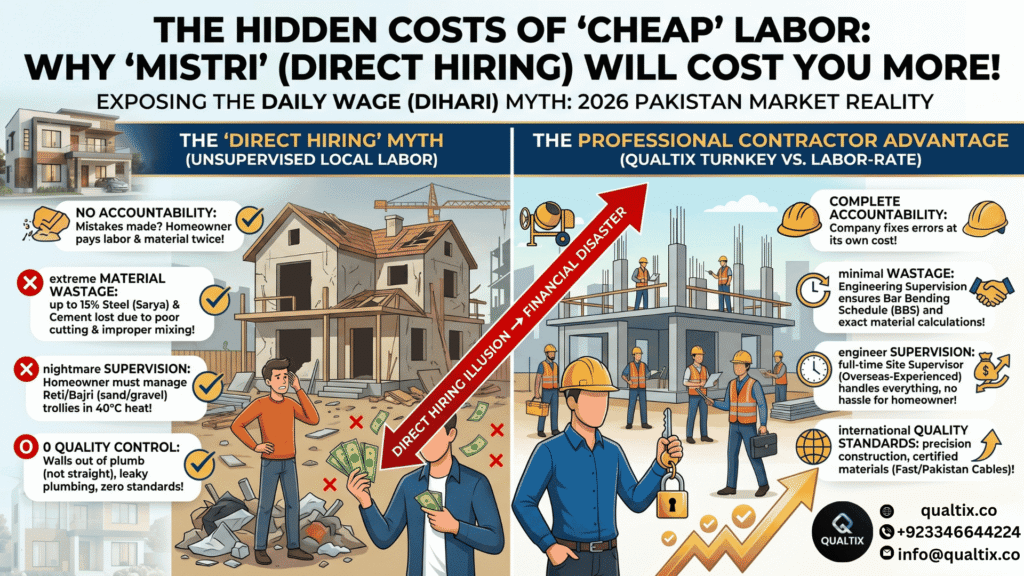
| The Homeowner’s Myth | The 2026 Site Reality |
| “I will save 15% by not paying a contractor.” | You will lose 20% to material wastage, theft, and re-purchasing ruined items. |
| “The Mistri knows how to build a house.” | The Mistri knows how to lay bricks; he does not understand load-bearing engineering, soil dynamics, or structural codes. |
| “I can manage the site by visiting after work.” | Construction emergencies happen at 10 AM. If you aren’t there, the labor sits idle, and you still pay their Dihari. |
| “I will buy my own materials and get the best price.” | Professional companies buy in bulk at wholesale rates. You will pay retail prices and get shortchanged on Reti/Bajri (sand/gravel) quantities. |
| “If the Mistri makes a mistake, he will fix it.” | Zero Accountability: The Mistri takes his daily wage and leaves. You pay twice for the labor and twice for the broken material. |
1. The “Material Wastage” Factor: The Invisible Financial Leak
When you hire daily-wage labor, their incentive is to finish the day’s tasks as comfortably as possible. They have absolutely no financial stake in conserving your materials. Because you are footing the bill, your site becomes a playground for extreme, unsupervised wastage.
The Sarya (Steel) Slaughter
Steel is one of the most expensive components of your Grey Structure. Professional engineers use a Bar Bending Schedule (BBS) a mathematical calculation that dictates exactly how a 40-foot steel bar should be cut to leave zero waste.
A local Mistri does not know what a BBS is. He will take a steel cutter and chop bars wherever it is most convenient for him. By the time your Lanter (roof slab) is poured, you will find hundreds of 2-foot and 3-foot steel scraps lying in the dirt wasted off-cuts that you paid premium 2026 market rates for. This alone can waste up to 10% to 15% of your total steel budget.
The Cement/Sand Ratio Disaster
Mortar (the mixture of cement and sand) requires specific ratios, such as 1:4 or 1:6, depending on the application. Unskilled labor prefers a “rich” mix (heavy on the cement) because it is stickier, smoother, and requires less physical effort to apply with a trowel.
Because you aren’t standing over the mixer counting every pan of sand, the labor will quietly consume 30% more cement than structurally necessary. You are literally burying your money inside the walls to make the laborer’s wrist movements easier.
Improper Storage and Weather Damage
Professional contractors establish secure, weather-proofed material depots on site. When you manage it yourself, a sudden summer thunderstorm in Islamabad can ruin 50 bags of cement stacked under a cheap tarp. Hardened cement is useless. Who absorbs that loss? You do.
2. The “Supervision Tax” (Time is Money & The Khuwari Factor)
Let us talk about the psychological and professional toll of acting as your own Thekedar. In Pakistan, this is known as absolute Khuwari (exhausting hassle).
Imagine this scenario: You are in a critical meeting at your office in Islamabad at 11:30 AM. Your phone rings. It is your Mistri.
“Bhai jaan, 2 bori cement aur thori si Reti (sand) kam par gayi hai. Jaldi bhej den warna labor farigh bethi hai.” (Brother, we are short 2 bags of cement and some sand. Send it quickly, otherwise the labor is sitting idle).
You now have two terrible choices:
- Leave Work: You leave your office, drive to the hardware store, buy the materials at premium retail prices, load them into your clean car, and drive to the site in the 40°C heat. You have lost half your workday, burned expensive fuel, and suffered immense stress.
- Let Them Wait: You tell them you will bring it after 5 PM. The entire team of 1 Mistri and 3 Mazdoors stops working for five hours. At the end of the day, you still have to pay them their full Dihari (around PKR 6,000 to 8,000 combined) for doing absolutely nothing.
The Tractor Trolley Mafia
Purchasing Reti (sand), Bajri (crush/gravel), and Ghassu (earth filling) requires dealing with local tractor trolley drivers. If you do not have professional measuring experience, they will deliver a trolley that is visually fluffed up but contains 20% less cubic feet of material than you paid for. A professional Site Engineer checks the volume of every single delivery; a homeowner simply hands over the cash.
3. The Rework Nightmare: Zero Financial Accountability
In construction, mistakes are extraordinarily expensive. What happens when a Mistri working on a daily wage makes a critical error?
- Out-of-Plumb Walls: He builds a brick wall that is slightly leaning. You don’t notice it until a month later when the painter tells you the wall is uneven. To fix it, you have to add an extra inch of plaster to level it out. You just paid for double the plaster, double the cement, and double the labor.
- The Plumbing Slope Disaster: He lays the bathroom floor without the proper slope towards the drain. Every time you shower, water pools in the corner.
The Bitter Reality: If a professional company makes these mistakes, they are legally and contractually bound to fix them. They will demolish the work, buy new materials out of their own pocket, and rebuild it.
If your daily-wage Mistri makes this mistake, he holds zero financial responsibility. You cannot sue him. You cannot make him buy new tiles. You simply fire him, hire a new Mistri, buy all the materials again, and pay the new guy his Dihari to fix the old guy’s mess. You pay twice.
4. The 2026 Financial Breakdown: A 5 Marla Case Study
Let us look at the actual math for a standard 5 Marla house (approx. 1800 sq. ft.) built in Wah or Rawalpindi in 2026.
Assume a professional contractor quotes you a Turnkey rate with a 12% profit margin. Homeowners often try to “save” this 12% by doing it themselves. However, a self-managed project almost always takes longer due to material shortages, labor absenteeism (Mistris not showing up after payday), and personal schedule conflicts.
The Cost of a 3-Month Delay:
- Lost Rent: If you are currently renting a house while building your new one, a 3-month delay costs you your current rent. (e.g., PKR 50,000 x 3 = PKR 150,000).
- Material Inflation: In 2026, prices change weekly. A 3-month delay in reaching the finishing phase means the tiles and aluminum windows you planned to buy will likely have jumped in price by 10%. (Cost impact: PKR 300,000+).
- Idle Labor & Pilferage: Paying labor while waiting for materials, plus the inevitable theft of small items (wires, cement) over an extended timeline. (Cost impact: PKR 100,000).
- Material Wastage (Sarya/Cement): (Cost impact: PKR 250,000).
Total Hidden Cost of Direct Hiring: PKR 800,000+
The Result: You have spent more money than the contractor’s entire profit margin, you have endured months of Khuwari, and you still possess a house built without engineering supervision.
5. The Professional Contractor Advantage (2026 Methods)
To protect your investment, you must treat your house like an engineering project, not a DIY weekend hobby. Professional firms like Qualtix offer two transparent ways to build:
1. Labor-Rate Contract (With a Company, Not a Mistri)
If you are adamant about buying your own finishing materials (tiles, lights, fixtures), you sign a Labor-Rate contract with a firm.
The Difference: The company provides the entire labor force, the shuttering, the machinery, and crucially, a full-time Site Supervisor/Engineer. The company guarantees the structural integrity and the timeline. If a wall is built wrong, the company fixes it for free. You supply the materials, but the company’s engineer calculates the exact quantities you need so there is zero wastage.
2. Turnkey Contract (The Ultimate Peace of Mind)
This is the gold standard for 2026, especially for Overseas Pakistanis or busy professionals. The company handles 100% of the project from drawing the map, passing it through the housing society (CDA, RDA, etc.), buying the Sarya, to installing the final light bulb.
Because professional firms buy materials directly from factories (bulk purchasing), they get rates you can never get. They absorb the inflation risks, they manage the labor, and they deliver the house on a fixed deadline. Your only job is to approve the 3D designs and receive the keys.
Stop Treating Your Life’s Savings Like an Experiment
Building a home is likely the single largest financial transaction of your entire life. You would not let an unlicensed mechanic rebuild your car’s engine to save a few thousand rupees, so why would you hand over a multi-million rupee structure to an uneducated, daily-wage laborer?
The “contractor’s margin” is not a tax; it is an insurance policy. It pays for structural safety, zero material wastage, timeline guarantees, and your personal peace of mind. It shields you from the Khuwari of the local markets and the stress of mid-day emergencies.
At Qualtix, we believe that building your dream home should be an exciting journey, not a daily nightmare. As a premier design, engineering, and construction firm serving Wah Cantt, New City Phase 2, and the wider Islamabad/Rawalpindi region, our sites are exclusively managed by Overseas-Experienced Civil Engineer. We enforce strict bar bending schedules, optimize every bag of cement, and deliver Turnkey excellence with absolute financial transparency.
Are you ready to build without the hassle? Stop fighting with tractor trolleys and let the professionals handle the heavy lifting. Contact Qualtix today for a professional site consultation and a detailed, transparent estimate.