As an experienced Civil Engineer and building contractor across Wah, Rawalpindi, and Islamabad, I sit across from frustrated homeowners every single week. The story is always the same: you spend a small fortune on premium designer paint or imported wallpaper for your living room, and within six months, the bottom three feet of the wall begin to bubble. Then comes the white, powdery dusting. Finally, the paint peels off in ugly flakes, leaving behind a dark, musty patch of ruined masonry.
In Pakistan, we call this Shor, Seem, or Silan (dampness and efflorescence). It is the absolute worst enemy of interior design. It destroys your home’s aesthetics, creates an unhealthy breathing environment, and drains your wallet as you enter an endless, doomed cycle of scraping and repainting every spring.
But what if I told you there is a way to permanently bypass this problem? You don’t always have to tear down the wall to save your interior. In the 2026 design market, we are defeating Silan using a highly technical, aesthetically stunning approach: The “Breathable Mask” Strategy using PVC Paling.
🚨 Signs Your Wall Needs Paling (Paneling)
Before we dive into the technical solution, you must diagnose the severity of your problem. Do not waste money on another bucket of expensive emulsion paint if you see any of these structural red flags:
- The “Salt” Bloom: A white, crusty powder pushing through the paint near the skirting boards.
- Blistering & Flaking: Paint that forms bubbles and eventually pops, peeling off in large strips.
- The Musty Odor: A permanent, stale, wet-earth smell in the room, especially during the monsoon season or when the room is closed.
- Discolored Patches: Dark brown or yellowish water stains mapping their way across your ceilings or walls.
- Crumbling Skirting: The cement or plaster right above the floor level turning into loose sand when you touch it.
If you check even one of these boxes, traditional paint or wallpaper will fail 100% of the time. You need a structural interior intervention.
💡 The Core Interior Concept: The “Breathable Mask” Strategy
To understand why PVC (Polyvinyl Chloride) paneling works, you must first understand why traditional methods fail.
When a homeowner sees a damp wall, the first instinct of a local painter is to scrape it, apply a thick layer of Plaster of Paris or wall putty, and repaint it. Some contractors might even suggest sticking a Gypsum Board directly onto the damp brickwork to hide the ugly patch.
This is a critical failure of material science. Both Plaster of Paris and Gypsum are highly porous materials. They act like giant sponges. When you put them over a damp wall, they actively “drink” the Silan from the bricks. The moisture transfers directly into your new finish. Within weeks, the plaster turns to mush, and the gypsum board sags, grows toxic black mold, and crumbles.
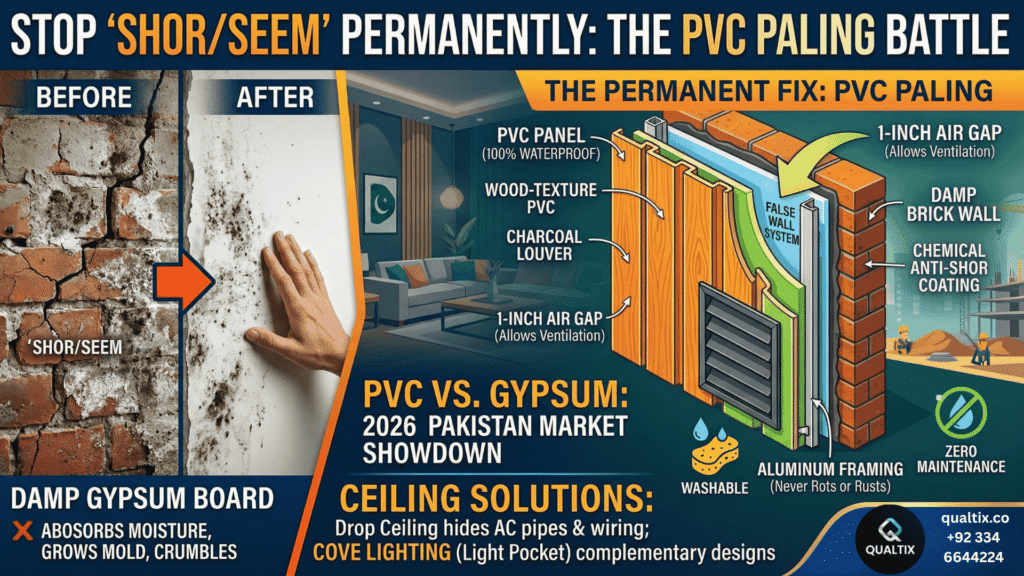
The “Breathable Mask” Strategy completely changes the rules of engagement. By using waterproof PVC Paling, we do not try to “cure” the moisture inside the brick (which often requires massive exterior excavation). Instead, we create a rigid, non-porous “false wall” that sits an inch away from the damp masonry. The Shor remains trapped behind the mask, unable to penetrate the plastic, leaving your interior finish looking pristine, dry, and luxurious.
📊 PVC vs. Gypsum: The 2026 Market Showdown
If you are renovating in Pakistan today, you must weigh your materials carefully. Here is exactly why PVC has overtaken Gypsum for damp-prone homes:
| Feature | Gypsum Board (Drywall) | PVC Paling (Panels) |
| Moisture Resistance | Very Low. Absorbs water, sags, and supports mold growth. | 100% Waterproof. Completely immune to Shor and Seem. |
| Maintenance | Requires scraping, re-puttying, and frequent repainting. | Washable. Wipe it down with a wet cloth and mild soap. |
| Installation Speed | Slow. Requires taping, mudding, sanding, and painting. | Fast. Pre-finished panels interlock. No painting required. |
| Durability in Humidity | Warps and swells during the Pakistani monsoon season. | Dimensionally stable. Unaffected by extreme humidity. |
| Cost-Benefit (2026) | Cheaper upfront, but requires continuous maintenance costs. | Slightly higher initial cost, but Zero maintenance costs. |
The Verdict: In a dry, upper-floor room with no plumbing nearby, Gypsum is fine for ceilings. But for any ground-floor wall suffering from capillary action (ground moisture rising up), PVC is the only permanent, cost-effective solution.
🛠️ The “Paling” Installation Hack: Getting It Right
A material is only as good as its installation. The biggest mistake homeowners make is letting unskilled labor glue PVC panels directly onto the damp wall. If you do this, the adhesive will fail as the wall sweats, and the panels will fall off.
The Essential Framing (Chaukhat)
PVC Paling must be installed on a skeletal frame, locally known as a Chaukhat.
- The Wood vs. Aluminum Rule: Traditional carpenters will try to build this frame using cheap wood (Partal). Do not allow this on a damp wall. The dampness will rot the wooden frame, and termites will follow the moisture. You must insist on an Aluminum Framing system. It will never rust, rot, or attract pests. The aluminum grid is drilled into the wall, and the PVC panels are screwed into the aluminum, creating a crucial 1-inch to 2-inch air gap between the wet brick and the dry panel.
Pro-Tip: The Ventilation Gap
When you seal a damp wall behind plastic, the moisture is trapped in that 1-inch air gap. If the trapped air cannot circulate, the trapped water vapor turns stagnant, leading to a terrible, musty odor that will permeate your bedroom.
The Hack: A skilled Interior Architect will always leave a small, discreet “Ventilation Gap” (often masked by a specialized skirting board or a shadow gap at the top near the ceiling). This allows the wall to “breathe.” The moisture slowly evaporates and escapes through natural air circulation, preventing structural rot and foul smells.
📋 The “Pre-Installation” Checklist
Do not just cover up a dying wall and hope for the best. Before the aluminum frame goes up, you must perform structural triage:
- Check for Structural Soundness: If the Shor has eaten away the mortar and the bricks are literally turning to dust when you touch them, you cannot drill a frame into them. The screws will slip out. You must first re-plaster the heavily damaged patches with a strong cement-sand mix.
- The “Anti-Shor” Chemical Wash: Before hiding the wall, brush it down and apply a heavy coat of a chemical waterproofing agent (like Sika TopSeal or a bitumen-based coating). While this won’t stop severe rising dampness entirely, it slows it down dramatically and kills existing mold spores before you seal the wall behind the PVC.
🎨 Aesthetic Trends for 2026: Beyond the “Plastic Look”
Ten years ago, PVC paneling looked cheap, glossy, and distinctly “plastic.” It belonged in commercial kitchens, not luxury living rooms. In 2026, manufacturing technology has revolutionized the material. Today, you can achieve a premium, 5-star hotel aesthetic at a fraction of the cost of real timber or imported stone.
- Fluted Panels (WPC & PVC): The biggest trend of the year. These are 3D panels with vertical ridges. They add immense architectural depth to a room and completely hide any unevenness in your original walls.
- Wood-Texture PVC: Modern high-definition printing means PVC panels now feature deep, embossed wood grains. You can have the warmth of an Oak or Walnut feature wall without the fear of termites or moisture ruining the wood.
- Charcoal Louvers: Dark, matte-finish charcoal panels are dominating modern drawing rooms, offering a moody, sophisticated backdrop for large flat-screen TVs and modern art.
💡 Ceiling Solutions for Modern Homes
Shor doesn’t just attack walls; top-floor ceilings often suffer from roof seepage, ruining traditional Plaster of Paris false ceilings.
Hiding the Mess
PVC panels are phenomenal for creating False Ceilings. Modern homes require extensive wiring for smart home systems, downlights, and the thick copper piping required for DC Inverter ACs. A PVC false ceiling hides this mechanical mess perfectly. If a wire shorts or a pipe leaks, you simply unclip a panel, fix the issue, and snap the panel back into place—no breaking plaster, no repainting.
The “Light Pocket” (Cove Lighting)
You don’t have to sacrifice luxury for practicality. Modern PVC installations easily accommodate the highly desired “Light Pocket” or Cove Lighting. By dropping the perimeter of the PVC ceiling and installing hidden LED strip lights, you create a soft, diffused “floating” effect that beautifully highlights the rich textures of the wood-grain or fluted PVC panels.
🛋️ The Qualtix Style Guide: Living Rooms vs. Bedrooms
How you use this material dictates the vibe of your home:
- The Living Room (The Statement): Use deep, bold textures. Create a media wall using Charcoal Louvers flanked by warm Wood-Texture PVC. Combine this with warm-white Cove Lighting in the ceiling to create an imposing, luxurious space for entertaining guests.
- The Bedroom (The Sanctuary): Keep it soft and calming. Use light Ash-wood textures or matte pastel PVC panels behind the headboard of your bed. The goal is warmth and comfort, knowing that the Silan behind the wall can no longer threaten your health or your furniture.
🚀 Take Back Your Home
You do not have to live with crumbling walls, and you shouldn’t have to repaint your house every single year. By embracing modern PVC Paling and the “Breathable Mask” strategy, you can permanently waterproof your interiors while massively upgrading your home’s aesthetic value.
At Qualtix, we specialize in turning moisture-damaged houses back into pristine, luxury homes. We are experts at integrating advanced PVC and WPC solutions that look like real wood but act like waterproof plastic specifically in area of Wah, New City Phase 2, and Kohistan Enclave. Tired of fighting a losing battle against Shor? Visit our website or contact our design consultants today to explore the latest 2026 PVC textures and let us engineer a permanent, beautiful fix for your home.