Building a house in Pakistan has never been for the faint of heart, but in 2026, it has become a masterclass in financial navigation. With 15 years on the ground in Wah, Rawalpindi, and Islamabad, I have watched the market evolve from predictable seasonal shifts to the high-volatility environment we face today.
For many, especially our Overseas Pakistani brothers and sisters or local middle-class families, a house isn’t just a structure; it’s the culmination of decades of hard work. However, I often see these dreams stall. You’ve likely seen them too: the “Adha-Ban-Gaya” (half-built) houses standing like grey ghosts in housing societies, abandoned because the owner ran out of cash before the windows could even be installed.
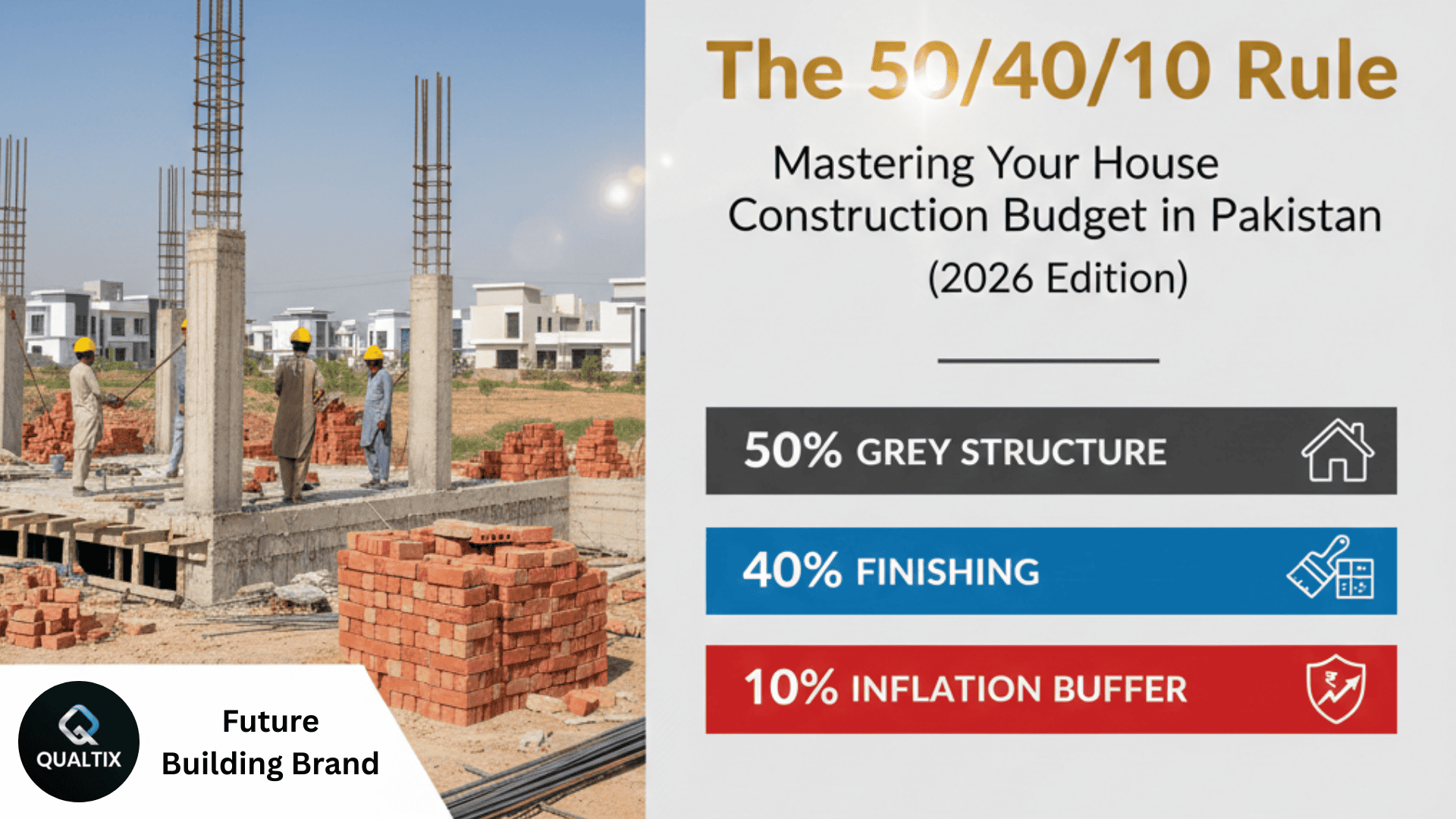
To avoid this, you need more than just a “rough estimate.” You need a strategy. This is the 50/40/10 Rule, the definitive framework for mastering your house construction budget in 2026.
The 2026 Market Pulse: What Does it Cost to Build Today?
Before we dive into the rule, we must face the numbers. Inflation and currency shifts have pushed per-square-foot rates to levels that would have seemed impossible five years ago. Whether you are building in New City Phase 2 or Kohistan Enclave, the 2026 baseline for a quality A-Grade house is:
- Grey Structure: PKR 2,800 – 3,200 per sq. ft.
- Finishing (A-Grade): PKR 3,500 – 5,000 per sq. ft.
- Total Project Cost: PKR 6,500 – 8,500 per sq. ft.
For a standard 5 Marla house (approx. 1,800 – 2,000 covered area), you are looking at a total budget between PKR 11.7 million and 17 million. For a 10 Marla house, double that.
Phase 1: The 50% Rule – The Unseen Strength (Grey Structure)
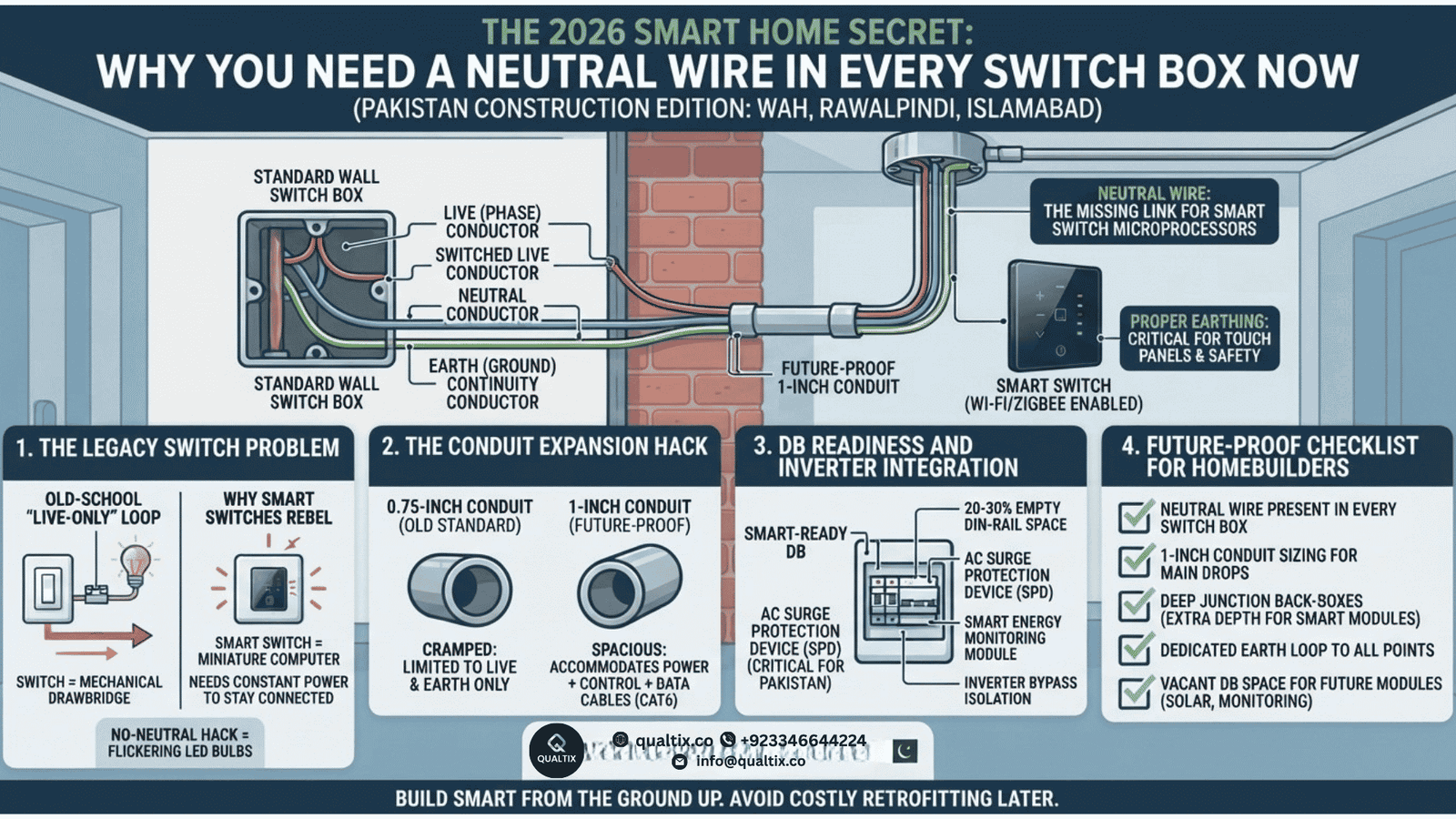
The first 50% of your budget must be locked into the Grey Structure. This is the “skeleton” of your home—the foundation, the walls, the Lanter (roofing), and the internal plumbing and electrical conduits.
Why the 50% is Non-Negotiable
In my 15 years, the most common mistake I see is “budget-bleeding” from the Grey Structure into the Finishing phase. People think, “I’ll save 5 Lakh on Sarya (Steel) now so I can buy a better chandelier later.” Stop right there. Your Grey Structure is the only part of the house you can never truly “fix” or “renovate” later. If your foundation is weak or your Sarya is sub-par, the house is compromised forever.
The Pillars of Grey Structure Costs:
- Sarya (Steel) & Cement: These are the twin engines of your budget. In 2026, prices fluctuate weekly. You must buy in bulk during price dips to stay within your 50%.
- Ghassu (Filling): Do not skimp on the quality of filling material. Proper compaction prevents your floors from settling and cracking two years down the road.
- Shor & Seem Prevention: This is the silent killer of houses in the Rawalpindi/Wah region. Investing in high-quality bitumen coating and polythene sheets for the foundation is part of this 50%. If you don’t spend this money now, you will spend ten times more later trying to hide dampness with wallpaper.
Phase 2: The 40% Rule – The Skin (Finishing with Intelligence)
Finishing is where most people lose control. It is the most emotional part of the build because it is what you and your neighbors actually see. The 40% covers your tiles, paint, woodwork, false ceilings, and fixtures.
The “Luxury Hack”: Making 40% Look Like 60%
In 2026, the cost of imported materials is staggering. To achieve an A-Grade look without an A-Grade bank account, I advise my clients to use the Focal Point Strategy:
- The Lounge & Guest Areas: Spend heavily here. Use premium, large-format porcelain tiles and elaborate false ceilings in the drawing room and lounge. This creates the primary impression of the house.
- The Private Quarters: In bedrooms and secondary areas, switch to high-quality local tiles or standard marble. To the naked eye, a well-coordinated local tile looks just as good as an imported one, but it costs 40% less.
- Woodwork Wisdom: Use solid Ash or Oak wood for the main entrance door, it is the handshake of your home. For internal room doors, use high-quality pressed doors with premium polish. They are durable, look great, and save hundreds of thousands of rupees.
Phase 3: The 10% Buffer – The Inflation Shield
This is the most critical part of the 2026 Edition of this rule. In previous years, we recommended a 5% buffer. Today, with the volatility in Wah and Islamabad markets, 10% is mandatory.
Ending the “Adha-Ban-Gaya” Syndrome
Why do projects stall? Usually, it’s because the owner spent 100% of their planned budget by the time they reached the woodwork, only to find that the price of aluminum for windows had jumped 20% since they started.
This 10% buffer is your “Emergency Lanter Fund.” It is for:
- Sudden spikes in copper wire prices.
- Unexpected changes in labor rates.
- Small design changes that always happen mid-build.
Do not touch this money for upgrades. If you reach the end of the project and still have it, use it for your landscaping or solar panels. But having it ensures that your construction never stops.
Specialist Advice for Overseas Pakistanis
Building a home from thousands of miles away adds a layer of anxiety. You are relying on photos, WhatsApp videos, and the honesty of relatives or contractors.
At Qualtix, we bridge this gap. Our firm specializes in professional Project Management and Technical Consultancy. We provide:
- Overseas-Experienced Civil Engineers: We speak the language of international standards and local execution.
- Transparency: Detailed progress reports so you know exactly where your 50/40/10 budget is going.
- Free Site Supervision: For projects in New City Phase 2 and Kohistan Enclave, we are offering 100% free site supervision for a limited time to ensure your vision is realized with precision.
Final Checklist for a 2026 Build
- Calculate by the Foot: Don’t guess. Take your total covered area and multiply it by PKR 7,500 for a realistic middle-ground starting point.
- The “Lanter” Milestone: Do not start the Grey Structure unless you have at least 60% of the total project cost already liquid.
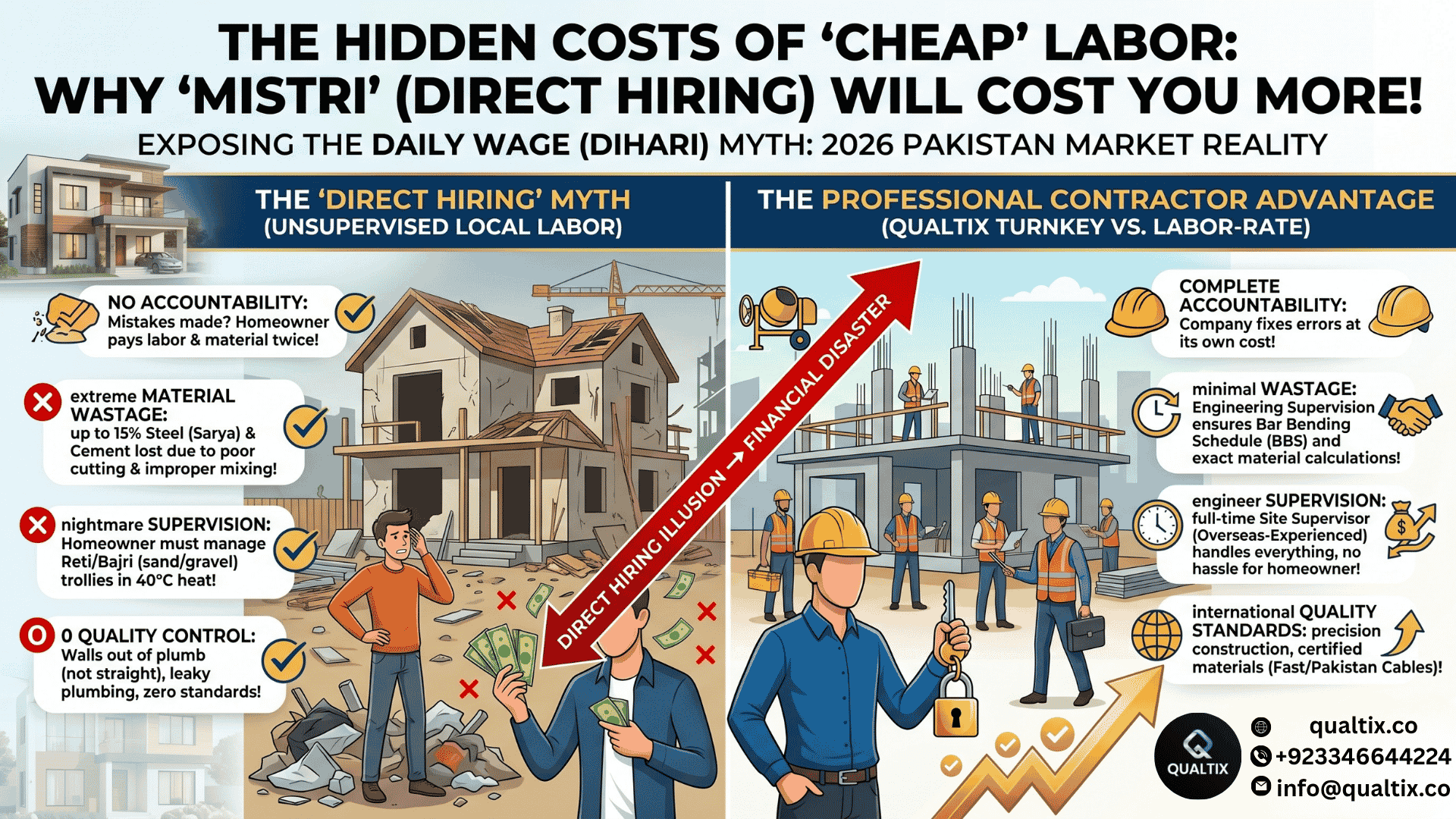
- Hire Supervision, Not Just Labor: A contractor builds, but an Engineer supervises. One technical mistake in the plumbing layout can cost you a fortune in “توڑ پھوڑ” (demolition) later.
Building a home in Pakistan is a marathon, not a sprint. By following the 50/40/10 Rule, you aren’t just building walls; you are building a legacy that will stand the test of time and economy.
Ready to start your journey? Would you like me to create a personalized budget breakdown based on your specific plot dimensions in Wah or Islamabad?