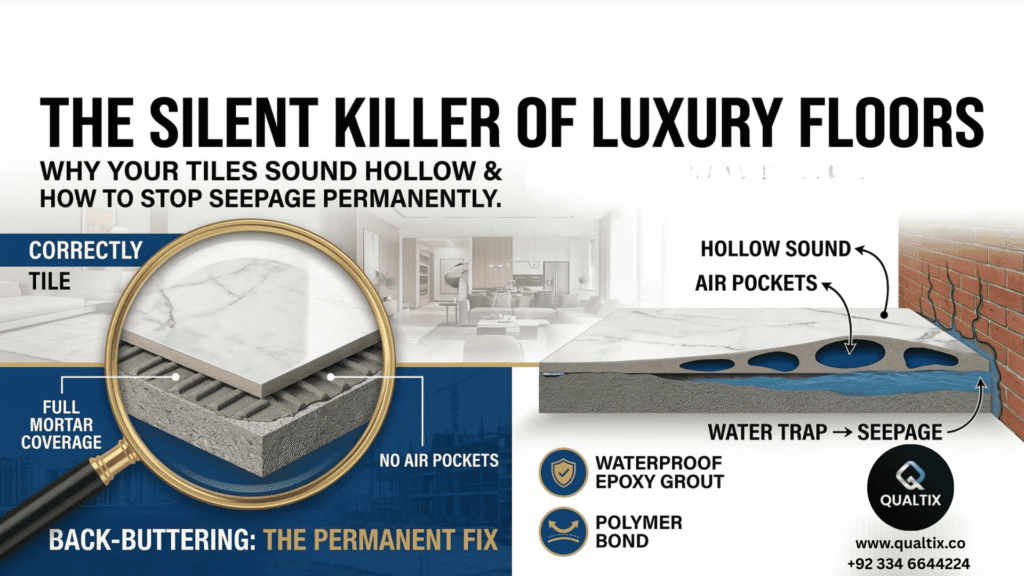
As a Senior Site Supervisor with over 20 years of experience and managing high-end residential projects across Wah, Rawalpindi, and Islamabad, I have witnessed a recurring, heartbreaking scenario. A homeowner pours millions of rupees into importing premium large-format Spanish or Italian porcelain tiles, or sources the finest A-grade local varieties. The floors look absolutely divine on the day of handover. Yet, fast forward just six months, and the dream shatters.
You walk across your stunning living room, and instead of a solid, grounding thud, you hear a high-pitched, echoing “click, click, hollow” sound. A few weeks later, you notice the skirting boards in the master bedroom starting to peel, accompanied by the dreaded white, powdery blister of Shor/Seem (dampness and efflorescence) crawling up your expensive designer paint.
In the high-end construction industry, we call this phenomenon the “Silent Killer.” It is not an aesthetic fluke; it is a catastrophic technical failure of the substrate preparation and application methodology. When your floors fail, your walls follow, and eventually, the structural integrity of your interior finishes is compromised.
This comprehensive guide is written to pull back the curtain on local construction practices. By understanding the engineering behind a perfect floor, you can ensure that the labor you hire in 2026 does not ruin your life’s investment.
1. The Anatomy of a Hollow Tile: Air Pockets and Structural Failure
To understand why a tile sounds hollow, you must first understand what lies beneath it. The most common complaint in Pakistani households is that hollow tapping noise. This occurs entirely because of Air Pockets—voids of empty space trapped between the bottom of the tile and the concrete floor (the substrate).
When a tile has air pockets beneath it, it is essentially suspended over a tiny crater. Porcelain is incredibly hard, but it is also brittle if unsupported. When subjected to pinpoint pressure—like the leg of a heavy solid oak dining table, the castors of a grand piano, or even the sharp heel of a shoe—the tile has no underlying support to absorb the weight. The result? The tile flexes infinitesimally and cracks, or the bond breaks entirely, causing the tile to “pop” loose.
The “Standard Method” (And Why It Fails)
If you watch a traditional local “Mistri” (mason) at work, you will likely observe the Standard Method. They mix a slurry of adhesive or pure cement, dump a dollop of it onto the floor, roughly spread it with a flat trowel (or worse, just leave it in a mound), and then slap the tile down, hammering it violently with a rubber mallet.
This method is a recipe for absolute disaster when dealing with modern large-format porcelain tiles (anything sized 60x60cm, 60x120cm, or larger). The mallet impacts only push the adhesive outward so far; they never push it all the way to the corners. The result is a tile that might have 60% adhesive coverage in the center, but the remaining 40% especially the corners and edges, is resting on nothing but trapped air.
The Core Technical Concept: “The Back-Buttering Hack”
In modern stone and tile engineering, eliminating these voids requires a technique known as Back-Buttering. This is the non-negotiable gold standard for 2026. Here is the science of how it works:
- Floor Application (The Ridges): The installer must apply the adhesive to the substrate using a specialized notched trowel (usually a 10mm or 12mm square notch for large tiles). The trowel is combed in straight, parallel lines. This creates uniform “ridges” and “valleys” of adhesive on the floor.
- Tile Application (The Buttering): Before the tile is laid, the installer takes the flat side of their trowel and forcefully applies a thin, flat, even layer of adhesive over the entire back surface of the tile. This is the “butter.”
- The Marriage: When the buttered tile is placed onto the ridged floor and pushed slightly back and forth (perpendicular to the ridges), the ridges collapse into the valleys.
Why this matters: Because the back of the tile is already “wet” with the buttered adhesive, it bonds instantly with the collapsing ridges on the floor. This forces all the air out through the grout lines, resulting in 100% coverage. Without back-buttering, the dry, dusty back of a porcelain tile will repel the adhesive ridges, creating micro-voids and, inevitably, that maddening hollow sound.
2. The Seepage Connection: How Your Floors Kill Your Walls
One of the most misunderstood concepts in Pakistani home construction is the origin of wall dampness. If you see peeling paint, bubbling plaster, or black mold on the lower half of your bedroom wall, and that wall is shared with a bathroom or kitchen, the culprit is rarely a burst pipe. Almost always, it is a poorly installed floor.
The Capillary Action Trap
When tiles are installed using the flawed “Standard Method” with plenty of air pockets, those voids do not just cause hollow sounds—they become hidden underground reservoirs.
Consider the local Pakistani context: we have a deeply ingrained habit of “flooding” our floors with buckets of water to wash them, rather than using damp mops. Whether it is washing the bathroom floor, hosing down a terrace, or thoroughly cleaning the kitchen, gallons of water are poured onto the tiles.
Water is relentless. It will find the path of least resistance. Over time, it seeps through microscopic cracks in cheap grout or around the edges of floor drains. Once it gets beneath the tile, it fills up those air pockets. Because the concrete substrate underneath is porous, it absorbs this trapped water like a sponge. Through a physics process called capillary action, this moisture travels horizontally through the concrete floor and wicks straight up into the adjacent brick walls.
This is the leading cause of Shor/Seem in luxury homes. You can scrape and repaint that bedroom wall ten times, but until you fix the hollow, improperly bonded bathroom floor, the seepage will return permanently.
3. The Great Debate: “Lasa” (Polymer Bond) vs. Pure Cement
If you want to start a fight on a construction site in Punjab, tell an old-school mason he cannot use pure cement to lay your expensive tiles.
Historically, floors in Pakistan were made of terrazzo (chips), marble, or highly porous ceramic tiles. These materials absorb water. Therefore, a slurry of pure cement and water (locally called “Neelu”) worked fine. The porous tile would drink the cement water, forming a mechanical lock as the cement crystallized.
However, in 2026, you are likely buying premium Vitrified Porcelain tiles. By definition, true porcelain has a water absorption rate of less than 0.5%. It is virtually glass.
Why “Neelu” is a Fatal Error for Porcelain
Because porcelain has near-zero Porosity, it cannot “drink” the cement water. Pure cement simply dries, shrinks, and detaches from the back of the tile. Furthermore, pure cement is entirely rigid.
In areas like Wah and Islamabad, we experience extreme temperature fluctuations—from near-freezing winter nights (5°C) to scorching summer afternoons (45°C). Materials expand in the heat and contract in the cold. This is known as Thermal Expansion.
The Solution: Polymer-Modified Thin-Set Mortars
Modern porcelain and ceramic tiles must be installed using high-quality polymer-modified adhesives (often referred to locally as “Lasa” or Bond, with brands like Stile, Laticrete, or Mapei leading the market).
These engineered adhesives contain latex and polymer additives. This does two critical things:
- It creates a chemical bond rather than just a mechanical one, gripping the glass-like back of the porcelain.
- It remains flexible even after curing. When the summer heat causes your concrete floor and your tiles to expand at different rates, the polymer bond stretches slightly, absorbing the stress. Pure cement, being rigid, will simply snap, causing the tile to pop off the floor.
4. The Grouting Secret: Why Epoxy is the Only 2026 Solution
You can execute a flawless, 100% coverage back-buttered installation with premium polymer bond, but if you fail at the grout lines, water will still penetrate the system.
For decades, the standard practice has been mixing white cement with colored powder to fill the gaps between tiles. This is a massive vulnerability. Cement-based grout is highly porous. In wet areas like bathrooms and kitchens, it absorbs dirty water, turns black with mildew, and eventually washes out due to the harsh acid-based cleaners commonly used in Pakistani households.
The Ultimate Waterproofing Seal: Epoxy Grout
For any high-end project in 2026, Epoxy Grout is the ultimate, non-negotiable solution for wet areas. Unlike cement, epoxy is made from synthetic resins and a hardener.
When cured, epoxy grout becomes as hard and impermeable as plastic. It is 100% waterproof, highly stain-resistant, and entirely immune to the harsh chemical floor cleaners that destroy traditional grout. By using epoxy grout in your bathrooms and terraces, you are essentially sealing the floor into one continuous, impenetrable waterproof membrane. Even if your domestic staff floods the floor daily, not a single drop will reach the substrate to cause seepage in your walls.
5. Common Site Mistakes: What to Watch Out For
As a homeowner, you must be the ultimate quality control inspector. Here are the three most common shortcuts negligent laborers take that will ruin your floors:
A. Installing on “Green” (Wet) Screed
A concrete floor leveling layer (the screed) contains massive amounts of water. This concrete must be allowed to “cure.” Depending on the weather in Punjab, a fresh screed needs at least 14 to 28 days to cure and release its internal moisture through vapor emission. If a contractor rushes and installs tiles on a “green” (wet) screed, the trapped moisture vapor will try to escape upward, creating hydrostatic pressure that literally pushes the tiles off the floor, destroying the bond.
B. The “Butt-Joint” Disaster (Zero Gaps)
Mistris take pride in installing tiles with “butt-joints”—pushing the tiles flush against each other so there is no visible gap, claiming it looks more “seamless.” This is a catastrophic engineering error. Because of the Thermal Expansion mentioned earlier, tiles move. If they are installed edge-to-edge with no gaps, the expanding tiles have nowhere to go. They will push against each other with immense force until they buckle, tenting upward and exploding off the floor. Always demand a minimum 2mm spacer between large-format tiles to allow for structural movement.
C. Walking on Tiles Within 24 Hours
A polymer-modified adhesive takes a minimum of 24 to 48 hours to achieve its initial set. If laborers, plumbers, or painters walk across freshly laid tiles before the curing process is complete, their weight causes micro-depressions. The bond breaks beneath the surface, and while the tile may look perfectly flat, it is now permanently hollow underneath. Traffic must be strictly prohibited in freshly tiled zones.
6. The Homeowner’s Troubleshooting Checklist
Do not wait until the house is finished to check the flooring. Use this checklist actively during the installation phase:
- The Tap Test: 48 hours after a section is laid, take a solid object (like the handle of a screwdriver or a wooden stick) and tap the center and all four corners of several tiles. You are listening for a dull, solid “thud.” If you hear a high-pitched, echoing “clack,” there is a dangerous air pocket beneath.
- The Level Check (Lippage): Slide a coin across the grout joints. If it catches on the edge of a tile, you have “lippage” (one tile is set higher than its neighbor). This indicates uneven adhesive application and poor leveling.
- Spacer Verification: Walk the site while the labor is working. Visually confirm that they are actively using plastic tile spacers (minimum 2mm) at every single intersection.
- The Trowel Check: Look at the contractor’s tools. If they only have flat trowels and no notched trowels, stop the work immediately. They physically cannot perform a proper installation without notched tools.
Protect Your Investment with Qualtix
Building a luxury home in Pakistan requires more than just capital; it requires rigorous technical oversight. The difference between a floor that lasts a lifetime and one that causes agonizing seepage within a year is entirely dependent on the engineering protocols followed during the messy, unseen stages of construction.
At Qualtix, we believe that true luxury is built on a foundation of uncompromised technical precision. Our projects across Wah and Islamabad are meticulously managed by Overseas-Experienced Civil Engineer who do not negotiate on quality. We enforce strict curing times, mandate the Back-Buttering Method for all large-format stones and porcelains, and utilize advanced epoxy grouting systems to ensure your investment is protected from the silent killers of the construction world.
Do not hand over millions of rupees of premium materials to “speedy,” unsupervised labor. Demand engineering excellence.
Are you struggling with poor workmanship on your site? Contact Qualtix today to schedule for a comprehensive technical audit of your ongoing flooring and waterproofing projects.