As an engineer and working in construction for more than a decade on high-end residential projects across Islamabad, Rawalpindi, and Wah Cantt, I witness the same terrifying scenario almost every day. A family moves into a beautifully designed, multi-million rupee home. The first evening of July arrives; they turn on the 1.5-ton Inverter AC in the master bedroom, someone switches on the iron in the hallway, and the microwave is fired up in the kitchen. Suddenly, there is a loud “pop” from the distribution box, and the entire floor goes dark.
In local terminology, the Ustaad (electrician) will casually say it’s a “Shortee” (short circuit) or that the WAPDA voltage dropped. But the reality is far more dangerous: your home’s electrical infrastructure was designed for 2005, not 2026.
When it comes to electricity, cutting corners does not just result in inconvenience; it results in electrical fires, melted conduits, and ruined appliances. To build a modern, trip-free, and fundamentally safe home, you must move beyond the basic switchboard and embrace the master engineering concept of Load Segregation, commonly known as “The Circuit Split.”
The Core Concept: Understanding Load Segregation
Most traditional Pakistani homes suffer from “Total Blackouts” because local electricians often wire multiple rooms—and multiple high-draw appliances—on a single, continuous loop protected by a single, under-rated circuit breaker. When the total electrical draw exceeds the breaker’s capacity, the breaker trips to prevent the wire from melting, plunging the entire floor into darkness.
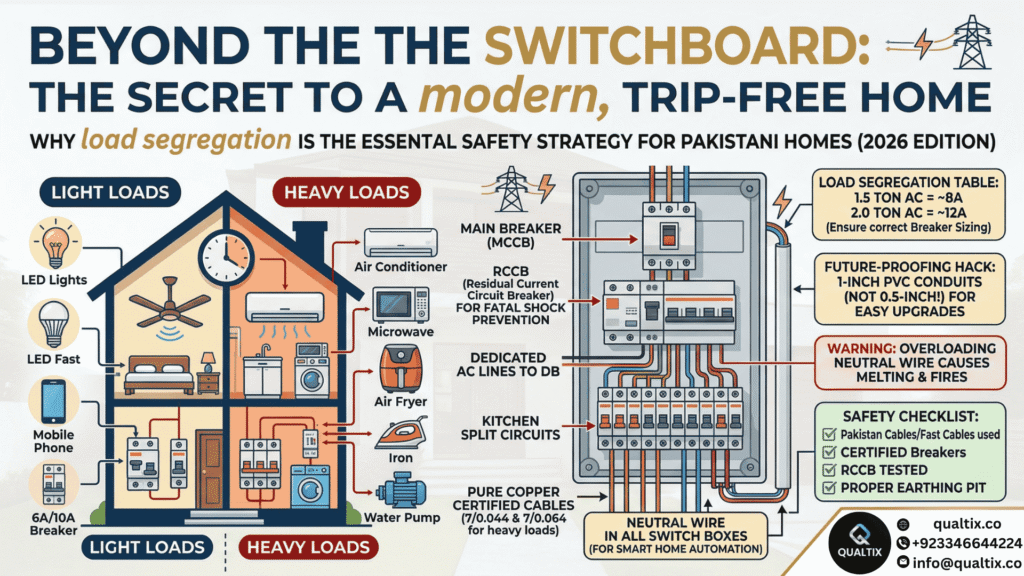
The Circuit Split is the 2026 engineering standard that fundamentally redesigns this architecture. It mandates the strict division of the house into two entirely separate wiring networks:
- Light Loads: LED lights, ceiling fans, mobile chargers, and basic wall sockets.
- Heavy Loads (Power Outlets): Air Conditioners (ACs), electric irons, water geysers, water pumps, and high-draw kitchen appliances.
By segregating these loads, a tripped breaker in the kitchen will never turn off the lights in your living room, keeping you safe and your home functional.
1. The Kitchen Crisis: The Power-Hungry Heart of the Home
Ten years ago, the kitchen required only one major power outlet for the refrigerator. Today, the modern Pakistani kitchen is an industrial power zone.
Consider the math: a modern Air Fryer draws around 1800 to 2000 Watts. A microwave oven draws 1200 Watts. An electric kettle draws 1500 Watts. If your electrician wires all the kitchen sockets on a single loop (a very common mistake to save wire), running the microwave and the air fryer simultaneously will pull over 3000 Watts through a wire designed to handle only 2000 Watts. The wire heats up, the insulation melts, and a fire starts inside your walls.
The Solution:
The kitchen must be treated as a “High-Risk Power Zone.” The refrigerator must have its own dedicated breaker so it never loses power if another appliance trips. Furthermore, the countertop power sockets must be split into at least two separate, dedicated circuits leading straight back to the main Distribution Board (DB).
2. The AC Dedicated Line: No Compromises Allowed
Air Conditioners are the absolute heavyweights of residential power consumption. Even with modern Inverter technology, the start-up current and sustained load of an AC require uncompromising wiring.
Every single Air Conditioner in your home must have a direct, unbroken line from the AC switch directly to the Distribution Board. It must never be “looped” or connected to the sockets in the bedroom.
The 2026 Wire Gauge Standards:
The biggest scam in local construction is the use of incorrect wire gauges (thickness).
- 3/0.029 (or 1.0mm² to 1.5mm²): Strictly for single LED lights and minor circuits.
- 7/0.029 (or 2.5mm²): This is the gold standard for standard room sockets, fans, and Light Loads. It should never be used for a 1.5-ton AC.
- 7/0.044 or 7/0.064 (or 4.0mm² to 6.0mm²): This is mandatory for Heavy Loads. A 1.5-ton or 2.0-ton AC requires a 7/0.044 pure copper wire. Using a 7/0.029 wire for an AC creates massive electrical resistance, which generates heat, melts the PVC conduit, and eventually causes a short circuit.
3. Distribution Board (DB) Anatomy & Life-Saving Tech
The Distribution Board (DB) is the brain of your home’s electrical system. A modern DB is not just a collection of random switches; it is a highly calibrated safety matrix.
- The Main Breaker (MCCB): This is the primary gatekeeper. If a massive surge comes from the WAPDA or K-Electric grid, this breaker shuts down the entire house to protect your appliances.
- Sub-Breakers (MCB – Miniature Circuit Breakers): These govern individual circuits (e.g., “Master Bedroom Lights” or “Kitchen AC”). They must be precisely sized. Putting a 32-Amp breaker on a wire that can only handle 15 Amps is a death sentence for your wiring—the wire will catch fire long before the breaker ever trips.
⚠️ WARNING: The Missing RCCB
The most tragic omission in Pakistani homes is the absence of an RCCB (Residual Current Circuit Breaker). Standard breakers protect wires from melting. An RCCB protects humans from dying. If a geyser leaks current into the water, or if you touch a wet switch in the kitchen, the RCCB detects a microscopic leakage (as low as 30mA) and cuts the power in milliseconds—faster than a heartbeat. If your DB does not have an RCCB, your home is not safe.
4. The “Future-Proof” Smart Home Hack
The way we interact with our homes is changing rapidly. Even if you aren’t installing a “Smart Home” system today, you will likely want Wi-Fi-enabled touch switches or automated lighting within the next five years. To prepare for this, you must override your electrician on two critical points:
- The Conduit Size: Standard practice is to use 0.5-inch or 0.75-inch PVC pipes inside the walls to save a few thousand rupees. In 2026, you must demand 1-inch PVC conduits. Why? Because 0.5-inch pipes get jammed easily. If you ever need to upgrade a wire, pull an ethernet cable, or replace a burnt line, a 1-inch pipe allows the wire to pass through smoothly without requiring you to break the plaster and ruin your walls.
- The Neutral Wire in the Switch Box: Traditional electrical wiring only brings the “Live” (Phase) wire down to the wall switch board; the “Neutral” wire stays in the ceiling. However, modern Smart Switches require constant power to maintain their Wi-Fi connection, which means they require a Neutral wire in the switch box. If you do not pull a neutral wire to every switchboard during construction, you will not be able to install true smart switches later.
5. Deadly “Mistri” Mistakes to Avoid
When auditing sites, I consistently find the same three lethal errors made by uncertified electricians trying to “save money” for the client:
- Under-Gauge Local Wires: Buying unbranded, under-gauge cables from local hardware stores is playing with fire. The copper is impure, creates high resistance, and severely damages expensive Inverter ACs.
- Overloading a Single Neutral Wire: Electricians often pull three separate Live wires for three different rooms but use only one shared Neutral wire to bring the current back to the DB. This overloads the single Neutral, causing it to overheat and melt inside the conduit, leading to hidden electrical fires.
- Zero Earthing (Grounding): Many homes have a three-pin socket, but the top pin (the Earth) is completely empty inside the wall. Proper Earthing requires a dedicated wire running from every heavy socket down to a copper rod buried in a chemical pit in your garden. Without earthing, any electrical fault in your metal appliances (like a fridge or washing machine) will pass the electric shock directly into the person touching it.
6. The 2026 Load Distribution & Breaker Sizing Guide
Use this chart to verify that your contractor is using the correct specifications. Note: Never oversize a breaker. The breaker must be the weakest link in the chain so it trips before the wire fails.
| Appliance / Load | Power Draw (Approx.) | Required Wire Gauge (Pure Copper) | Recommended MCB (Breaker) Size |
| Basic Lighting (LEDs, Fans) | Under 500W | 3/0.029 or 7/0.029 | 6 Amp or 10 Amp |
| General Room Sockets | 1000W – 2000W | 7/0.029 (2.5mm²) | 16 Amp |
| Kitchen Appliances (Microwave/Oven) | 1500W – 2500W | 7/0.036 or 7/0.044 (4.0mm²) | 20 Amp |
| 1.5 Ton AC (Inverter) | 1500W – 1800W | 7/0.044 (4.0mm²) | 16 Amp or 20 Amp |
| 2.0 Ton AC (Inverter) | 2200W – 2600W | 7/0.044 or 7/0.064 (6.0mm²) | 20 Amp or 32 Amp |
| Instant / Electric Geyser | 2000W – 3000W | 7/0.044 or 7/0.064 (6.0mm²) | 20 Amp |
🛑 The Homeowner’s Safety Checklist
Before the walls are plastered and the wires are hidden forever, walk through your site and check the following:
- Brand Verification: Are the wire coils physically stamped with a certified brand name (e.g., Pakistan Cables, Fast Cables)?
- Dedicated AC Lines: Is there a separate pipe and wire running directly from every AC point to the main DB?
- The Kitchen Split: Are there at least two separate circuits for the kitchen countertop sockets?
- RCCB Installed: Look at the DB box. Is there a larger breaker with a small “Test” button on it? If not, you do not have life-saving RCCB protection.
- Earth Wire Verification: Open a 3-pin power socket. Is there a green/yellow wire connected to the top pin? If not, your home has no grounding.
Engineer Your Peace of Mind
Electricity is the central nervous system of your house. It powers your comfort, protects your expensive investments, and literally keeps your family alive. This is the one area in construction where compromising on quality or engineering standards is absolutely unacceptable.
At Qualtix, we treat electrical engineering with the gravity it demands. As a premium design and construction firm serving Wah Cantt, Islamabad, and Rawalpindi, our Overseas-Experienced Engineer calculate every single load before a single wire is pulled.
We exclusively use 99.9% pure copper certified cables (such as Pakistan Cables or Fast Cables). We mandate 1-inch conduit piping, strictly enforce the Circuit Split strategy, and never hand over a home without a fully tested, RCCB-protected Distribution Board.
Don’t let an uncertified electrician turn your dream home into a fire hazard. Build with precision. Build with safety. Contact Qualtix today to ensure your home is engineered for the future.