As a Senior Civil Engineer consulting on residential projects across Wah, Rawalpindi and Islamabad, Pakistan, I often tell my clients that the finishing phase like the tiles, the paint, the chandeliers is just the “makeup.” The true integrity of your home lies in its Grey Structure. This is the skeleton of your house. If the skeleton is weak, or if it is compromised by structural pests, no amount of imported Italian marble will save your investment.
When laying the foundation for a home in 2026, homeowners face two critical, high-stakes decisions during the Grey Structure phase: choosing the right masonry material (Bricks vs. Concrete Blocks) and executing the foundational soil treatment.
This guide will break down the engineering realities of both choices, helping you build a home that is structurally sound, thermally efficient, and permanently protected from beneath.
The Great Debate: Red Bricks vs. Concrete Blocks
For generations, the Pakistani construction industry has run on a single staple: the baked red clay brick. However, modern engineering standards, fluctuating material costs, and seismic considerations have brought concrete blocks to the forefront of residential construction. Let’s evaluate both options scientifically.
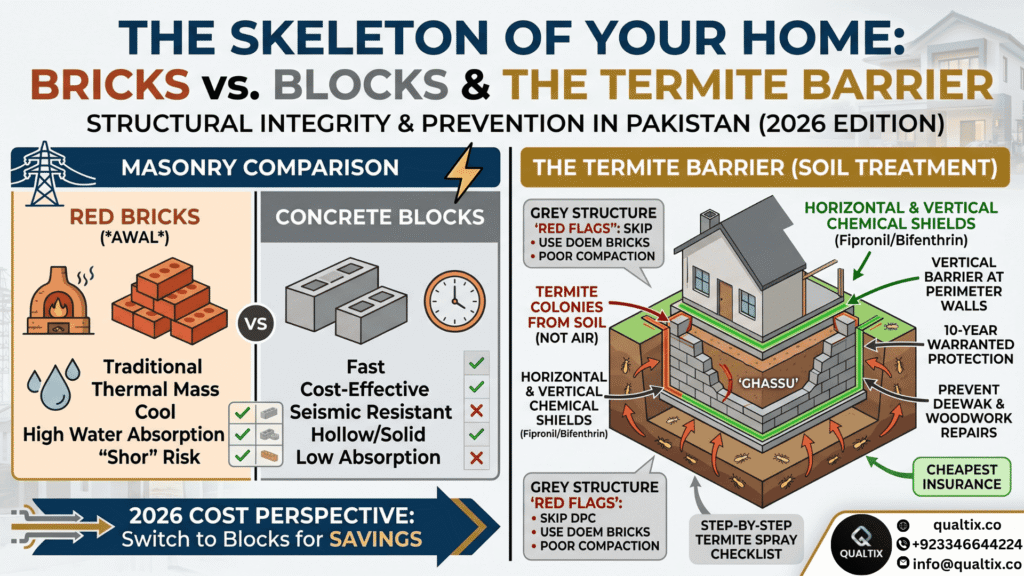
1. Red Bricks (Awal Bricks)
The traditional Class-1 (Awal) red brick is made from locally sourced clay and fired in a kiln.
- The Pros: Bricks possess excellent Thermal Mass. They absorb heat slowly during the day and release it at night, which is a massive advantage in the scorching summers of Lahore or Multan.
- The Cons: Bricks are highly porous. They have a high water absorption rate, making them highly susceptible to Efflorescence (the white salty powder that ruins paint, locally known as Shor). Furthermore, the quality of bricks in 2026 varies wildly from kiln to kiln, making consistency a challenge.
2. Concrete Blocks (Solid and Hollow)
Concrete masonry units (CMUs) are manufactured using a mix of cement, sand, and aggregate.
- The Pros: Speed and uniformity. Blocks are larger, meaning walls go up exponentially faster, drastically reducing your labor costs. From a structural engineering standpoint, hollow concrete blocks are lighter, which reduces the “dead load” on the foundation. In active seismic zones (like Islamabad and the northern areas), a lighter structure inherently performs better during an earthquake. Furthermore, they have minimal water absorption, severely reducing the risk of Shor.
- The Cons: They have higher Thermal Conductivity than clay bricks. An uninsulated block wall will transfer outside heat into your home faster than a solid brick wall.
The 2026 Cost Perspective & Verdict
In the current economic landscape, building your home’s skeleton with concrete blocks can save you roughly 15% to 20% on masonry costs (factoring in reduced labor, less mortar usage, and the cost of the units themselves).
The Verdict: Choose Red Bricks if you are building in the extreme heat zones of Central/Southern Punjab and have the budget to endure a longer construction timeline.
- Choose Concrete Blocks if you are building in the Potohar region or northern areas, if you are building a multi-story structure requiring lower dead loads, or if you want to optimize your budget without sacrificing Compressive Strength.
Comparison Table: Bricks vs. Blocks
| Feature | Red Bricks (Awal) | Concrete Blocks |
| Compressive Strength | Good (Variable by kiln) | Excellent (Highly consistent) |
| Thermal Insulation | High (High Thermal Mass) | Moderate (Transfers heat faster) |
| Construction Speed | Slower (Labor-intensive) | Very Fast |
| Efflorescence (Shor) Risk | High (Highly porous) | Very Low |
| Cost in 2026 | Premium | Highly Cost-Effective |
The “Cheapest Insurance” Hack: The Termite Barrier
Whichever material you choose for your walls, it will eventually interface with your woodwork like doors, wardrobes, and cabinets. In Pakistan, the silent destroyer of this woodwork is the termite, locally known as Deewak.
The biggest myth in residential construction is that termites fly in from the outside. They do not. They come from the soil beneath your house. Termites live deep underground in massive colonies. They build microscopic mud tubes up through your foundation, bypass your concrete, and eat your expensive Ash or Oak wood doors from the inside out. By the time you see the damage on the surface, the wood is entirely hollow.
The ultimate structural hack is this: Soil Treatment during the Grey Structure phase. Spraying the foundation before the floors are sealed costs a microscopic fraction of your total budget, but it is the cheapest, most effective insurance policy you will ever buy. If you saved money by switching to concrete blocks, reinvest that saving here.
How the Barrier Works
A professional termite barrier involves establishing both horizontal and vertical chemical shields using industrial-grade termiticides (specifically active ingredients like Fipronil or Bifenthrin, which don’t just repel termites—they eliminate the colony).
- The Horizontal Barrier: Once the foundation trenches are backfilled with Ghassu (earth filling), the entire surface area must be flooded with the chemical solution before the Lean Concrete (Kacha) is poured for the floor.
- The Vertical Barrier: The soil immediately touching the exterior and interior perimeter of the foundation walls is heavily injected with the chemical, ensuring no termite can crawl up the masonry.
⚠️ WARNING: The Cost of Skipping Soil Treatment
Skipping the pre-construction termite spray might save you Rs. 30,000 to Rs. 50,000 today. However, treating an active termite infestation in a finished home requires drilling hundreds of holes through your expensive floor tiles to inject chemicals blindly into the soil. It ruins your aesthetics, costs triple the original amount, and often happens after hundreds of thousands of rupees worth of woodwork has already been destroyed.
Grey Structure “Red Flags” on Site
When managing your build, watch out for these catastrophic engineering errors:
- Using Doem (Second-Class) Bricks in Load-Bearing Walls: Unscrupulous contractors will mix under-baked, yellowish bricks (Doem or Soem) to save money. These bricks have zero compressive strength and will crush under the weight of the roof slab. They must be strictly rejected from the site.
- Skipping or Breaching the DPC (Damp Proof Course): The DPC is a layer of concrete and bitumen applied at the plinth level. It acts as a waterproof membrane. If the DPC is skipped, or if a plumber breaks through it to lay a pipe, capillary action will draw groundwater (and termite mud tubes) straight up into your walls. The termite barrier and the DPC must work together as a unified shield.
- Poor Soil Compaction: Before the termite spray and the floor lean are applied, the Ghassu must be mechanically compacted in 6-inch layers using a plate compactor or roller. If the soil is loose, it will settle over the next few years. When the soil sinks, your floors sink with it, breaking your tiles and snapping your underground plumbing pipes.
📋 The Step-by-Step Termite Spray Checklist
Ensure your site supervisor or contractor strictly follows this protocol:
- Verify the Chemical: Check the drums on site. Ensure the chemical contains Fipronil (min 2.5%) or Bifenthrin. Reject cheap, unbranded agricultural pesticides.
- Timing is Everything: Ensure the spray happens after the plumbing pipes are laid and the Ghassu is fully compacted, but immediately before the Lean Concrete is poured.
- The Perimeter Trenching: Ensure a 6-inch deep trench is dug around all interior foundation walls and flooded with the chemical.
- The Saturation Rule: The soil should not just be “misted”; it must be saturated. The standard application rate is usually 4 to 5 liters of chemical emulsion per square meter.
Engineer Your Home for Generations
Building a home is not a place for guesswork or dangerous cost-cutting. The decisions you make during the Grey Structure phase are permanent. A structurally optimized skeleton paired with an impenetrable termite barrier forms the bedrock of a home that will stand for generations without requiring agonizing repairs.
At Qualtix, we do not compromise on the science of building. Our sites are audited by senior civil engineers who enforce rigorous material testing, whether you opt for Class-1 Bricks or High-Strength Concrete Blocks. Furthermore, we consider foundational security non-negotiable.
Are you planning your 2026 build? Contact Qualtix today for a comprehensive structural consultation, or request a Grey Structure quote that includes our premium, 10-year warranted termite protection protocol as a standard baseline. Build with precision. Build with Qualtix.